Fires in crowded public spaces are a serious matter. A fire in an underground railway is an extreme example, and history provides some horrific case studies. Many readers will remember the fire at King’s Cross St Pancras tube station in London in 1987, in which 31 people died.
More recently, 192 people died in 2003 in Daego, South Korea, when an arsonist set fire to a subway train as it arrived at a station. A second train arrived at the station soon after and the fire spread further.
New Zealand’s first underground railway, the City Rail Link, will open later this year in Auckland. The dual tunnels connect four stations, two of them underground. Much thought has gone into how passengers would be evacuated should a fire start in the underground section. A few months ago, with the system under real-life stress testing, this scenario was tested with hundreds of people on trains in the tunnels.
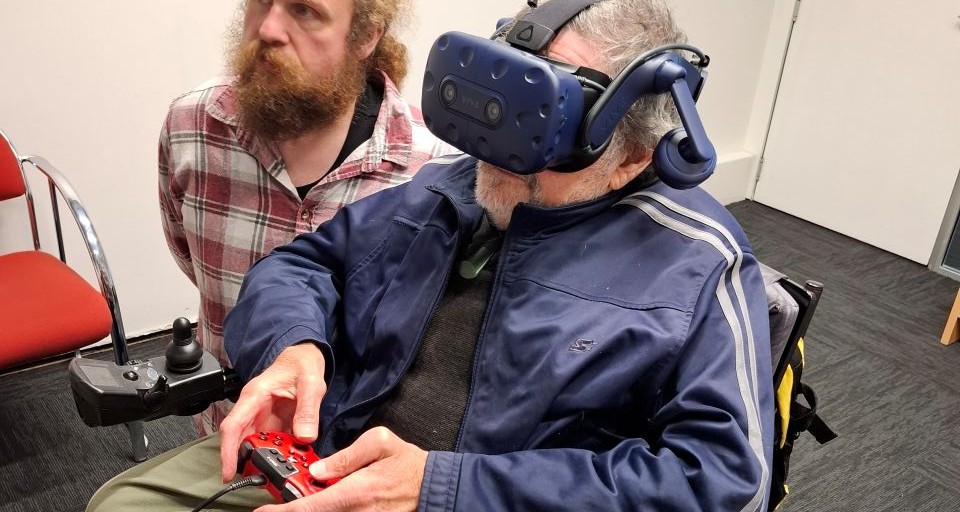
But long before then a human factors study using VR technology recruited 84 highly diverse people to test how they would evacuate under simulated fire conditions, with billowing smoke, alarms going off and all manner of chaos.
Analysis of the results helped to confirm what worked well and led to a couple of design changes in the real tunnel.
Recruiting participants
Louise Malcolm, who was part of the human factors team on the simulation project, works for the consultancy WSP, one of the members of the Link Alliance charged with delivering the stations, tunnels, rail systems for the City Rail Link. She says that while similar VR-based evacuation studies have been conducted elsewhere, this one broke new ground by continuing the evacuation scenario beyond the point where others had stopped. The findings are of interest internationally.
The VR part made use of existing digital models already created for the project. It replicated a full-scale tunnel, train, walkway, cross passage (XP), and non-incident tunnel connection, including realistic smoke, fire, signage, lighting, and audio cues.
Recruitment of the subjects focused on getting a representative sample of the population but with special emphasis on people who might face above average difficulty in evacuating: people with limited mobility, people with low vision or hearing, people with limited English, and so on.
“We’re lucky that it’s a project with a lot of public interest, so people were quite keen to take part!”
Gathering the data
Some participants were familiar with VR technology but most weren’t, so each person was first put through a familiarisation exercise: the VR simulated an above-ground station and required them to find their way through a door and down an escalator to reach a wayfinding decision point: how to reach the desired platform?
Malcolm says when participants went through the actual evacuation scenario, she and other monitors avoided interacting with them, intervening only if they were having trouble with the VR controller or other technical issue. It really was self-evacuation, with no one to help.
Participants wore special glasses with eye tracking, so later analysis showed where they were looking during their attempts to get out of the train, escape the fire and smoke, and find their way to the nearest station (rather than, as some did initially, seek to escape by walking further into the tunnel). This showed which cues worked: exit signs, direction signs, audio warnings, automated instructions and so on.
Some participants verbalized what they were doing (and why) during their self-evacuation exercise. Others watched a video replay of their actions and talked the researchers through their decision making at each point, both cases supplying rich qualitative data on decision-making, confidence, comprehension, and evacuation strategy.
Some interesting results
The outcome was that 91% of participants exited the train immediately, minimising dwell time in hazardous smoke and improving survivability, while 81% detected and used the cross passage (XP), matching international best-practice outcomes seen in European smoke-filled tunnel tests.
Importantly, introducing a station wayfinding sign (eg ‘Karanga-a-Hape Station 350m’, with a directional arrow, rather than just ‘Exit’) opposite the cross passage was found to produce a 20% reduction in evacuation time – 39 seconds – which has been estimated would save up to 45 lives in the worst-case tunnel fire. Such signs, not anticipated in the original design, were added to the tunnels.
Malcom explains that in tunnels and deep stations, even short pre-evacuation or wayfinding delays critically reduce survivability because toxic smoke, poor visibility, and heat develop faster than people can self-rescue.
This is the world-first aspect of the exercise. Similar VR-based evacuation exercises stopped when participants had reached the XP. This one tested what participants did next, once they emerged from the XP, quantifying confusion and return-to-XP behaviour in the non-incident tunnel.
Happily, participants with differing vision, mobility, language/culture and cognitive needs still achieved successful evacuations, verifying that the design is inclusive and robust across user groups.
Something that was in the original design but was removed as a result of the VR evacuation trial was a ‘sounder’, like an alarm trying to draw people’s attention to their evacuation route.
“We found it wasn’t successful. It had no significant effect. It was interesting because when you do this kind of testing you generally add more things in, but in this case we could remove something.”
Inclusive design important
Malcolm says while VR was the technology used, its best to regard it as the tool to support what was really a human behaviour project. She found it interesting to see how people used different cues to help get them out safely: colours, words, arrows, audible messages.
“It highlights the importance of an inclusive design approach where you’ve got multiple cues, because people interpret things differently.”
Having a highly diverse participant group was also essential, she says. “We all have difficulty putting ourselves into other people’s shoes, so testing with people who have that lived experience is important to capture those perspectives. Because you never know how someone else sees the world.”
A transferable methodology
The principle, she says, is entirely transferable to other design projects where people gather and could face a nightmare scenario requiring rapid evacuation. The trick, she says, is to schedule such trials before the design is finalised so that the results can inform physical changes.
As for this particular result, she’s due to speak about it at an Australian conference later this year.
“It’s important to take opportunities to share. On City Rail Link we learned a lot from other international projects, particularly the international team that makes up the Link Alliance.
“It’s nice to be able to share back.”