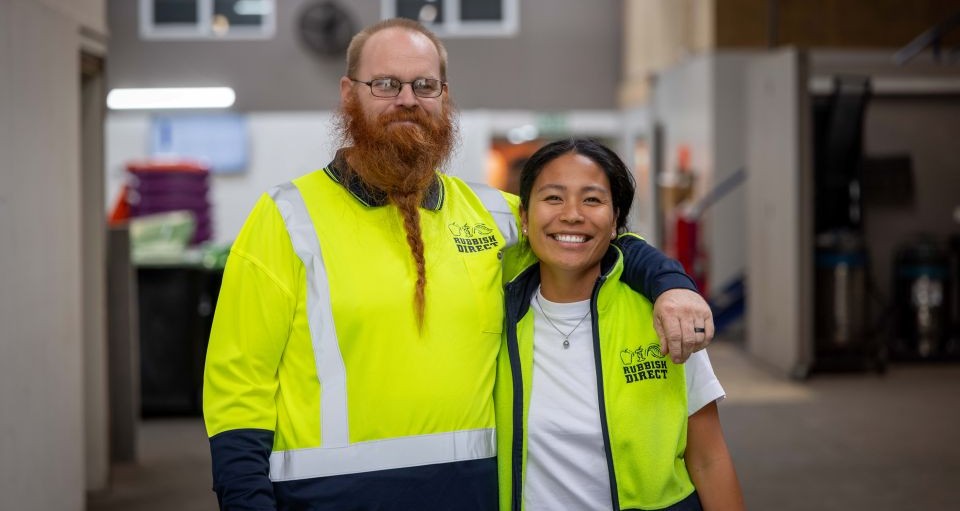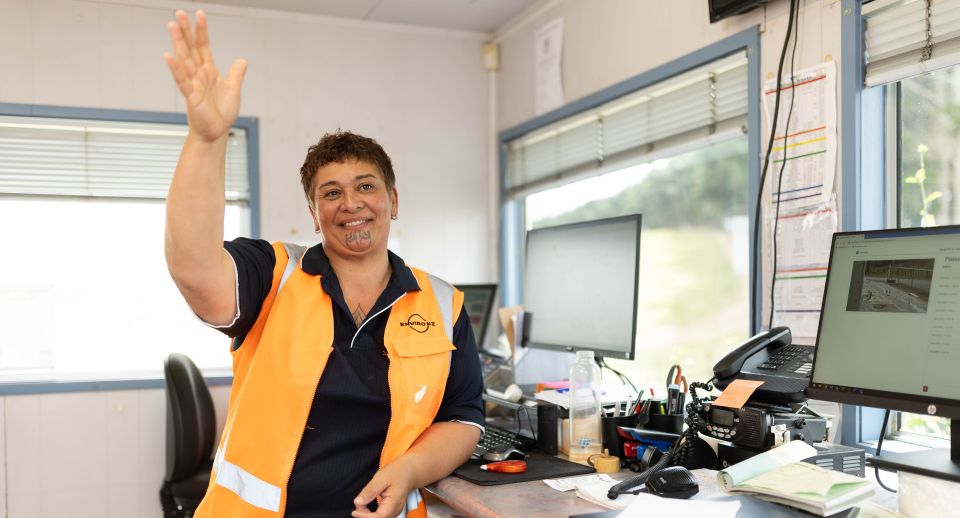
When Annette Tata first started running learning teams, she made a very human mistake: she arrived with her own ideas about answers.
Then workers started showing her things she had never seen.
A shed positioned in the path of potential runaway trailers. Communication problems hidden in everyday language. Hazards that looked obvious only after someone pointed them out.
For the winner of the Health & Safety Rep category at this year’s Awards, the biggest lesson has been surprisingly simple: stop assuming, start listening.
Tata never expected health and safety to become such a significant part of her working life. After more than 17 years employed at the freezing works, joining Enviro NZ’s Hampton Downs site as a weighbridge operator was supposed to be her “relax job” – a chance to finally slow down.
“I’d just go to work and do my job and come home,” she says. “But I could see there were areas that needed some attention within the company. Someone willing to put their hand up and say ‘I’ll look into that’ or ‘I’ll give you a hand with that’. And that’s really how it started.”
Involved in the EU
A major turning point came through Enviro NZ’s enforceable undertaking following a 2020 incident where a driver was struck and fatally injured by a loader. While Tata wasn’t at with the company at the time, her husband was and she was aware of the incident. Once at Enviro NZ she became deeply involved in the EU work, participating in investigations, meetings and discussions examining what had happened and how similar events could be prevented in future.
As a health & safety rep, management included Tata throughout the process, taking her out of the weighbridge and finding cover so she could attend. “I was lucky because management involved me the whole time,” she says. “Anything to do with the enforceable undertaking, they included me in the meeting.”
Understanding work as done
The process changed the way she thinks about safety.
“It’s had a huge impact,” she says. “You always hope that you keep safe, but you don’t always think about the worst scenario all the time. I find myself not taking things more seriously so much as looking at them in a different view.”
What stood out to her was not the paperwork or legal processes. It was the effort to understand work as it was actually done.
The effort produced real change on the ground. Tata sites one example around the tipping pad, which previously had trucks coming and going while loaders cleared it, with people around at the same time. Now boom gates stop trucks entering when a loader is working the pad and no pedestrians are permitted in the zone while it’s operating.
Running learning teams
The EU also introduced Hampton Downs to Learning Teams, a worker-engagement approach that has become central to Tata’s development as an HSR and something she credits with increasing H&S influence through enabling everyone to see results.
“I find it the best thing, I really do. I wish I’d had learning teams in all of my jobs,” she says.
“It was funny to start with because I was going into meetings with my own ideas. It really showed me that I’ve got to park them and just listen.”
One discussion involved a loader parked on a tipping pad. Workers pointed out that a runaway trailer could travel directly towards a nearby shed.
“They hadn’t really thought about it when they put the shed there,” Tata recalls. “Can we get it moved? We can. Just like that.”
Maintaining curiosity
The teams run monthly, covering everything from incident reviews to diversity in the workplace and seasonal readiness. Notably, the health and safety meetings that feed into them run without management present – a change management themselves suggested after workers clammed up when managers were in the room. Small issues stay alive through tailgate talks: workers chased up a heater promised the previous winter, a reminder that keeping topics visible matters as much as raising them in the first place.
Curiosity threads through all of it. Tata recalls a worker who misunderstood an instruction because of unfamiliar Kiwi vernacular phrasing. It was a moment that became a valuable discussion about communication rather than a case of someone “not following instructions”.
Earning trust
Asked what she is most proud of as an HSR, her answer is immediate. “Trust would be the biggest thing for me.”
That trust isn’t a tick-box exercise – it’s coming back to workers even without an instant answer. Where staff once needed reminding to raise issues, they now come to her at the weighbridge, unprompted.
It hasn’t all been smooth. At one point Tata considered resigning, feeling she couldn’t do the role justice alongside her weighbridge job. She raised it with her health and safety advisor and management. The company restructured her health & safety time from four hours a week to half a day, every day, plus a pay increase.
She credits ongoing support from Enviro NZ’s H&S team for helping her navigate difficult issues, including learning to “stop and back up a little” rather than push too hard.
Looking ahead, Tata isn’t entirely sure what’s next. “I’d like to do more, but I’m not sure how,” she admits. Her guiding philosophy, however, hasn’t changed: safety is never a finished job. There’s always something more to learn, improve and – above all – a worker’s voice worth listening to.